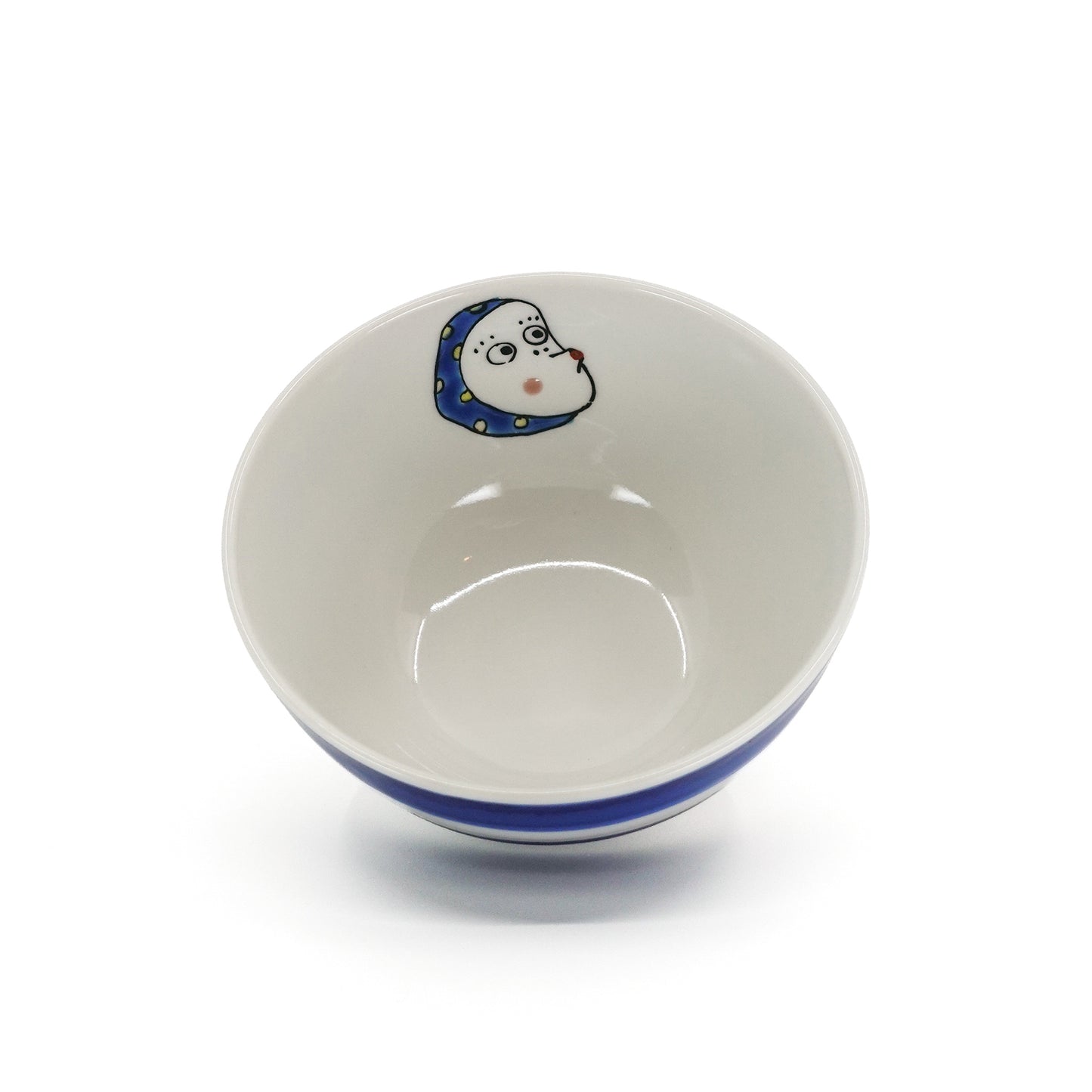
Otafuku-Hyottoko Set of 2 Bowls
In stock
Delivery within the UK in 2-5 days
Free shipping over £50, Free express shipping over £150
Couldn't load pickup availability
Immerse yourself in the vibrant heritage of Kutani ware, a craft celebrated for over three centuries. This tradition is defined by "Gosu" (intricate cobalt blue outlines) and the "Gosai" palette, where red, yellow, green, purple, and deep blue pigments are applied with a generous thickness. This specialised overglaze technique results in a striking, raised texture that lends every piece a powerful and tactile presence.
These bowls are a masterful expression of this storied history, brought to life by the skilled artisans at Futaba Kiln. Known for their dedication to preserving the authentic spirit of Kutani ware, Futaba Kiln excels in creating pieces that feel simultaneously traditional and perfectly suited for the modern table. Their work captures a chic, Japanese-modern aesthetic, offering vividly expressive designs that honour the past while enhancing the beauty of contemporary living.
The design centres on the classic Otafuku and Hyottoko motifs, legendary figures in Japanese folklore known for bringing luck and laughter. To create a coordinated set, the collection features two distinct colour variants: a vibrant red and white version and a serene blue and white alternative. These contrasting palettes highlight the versatility of Kutani pigments while celebrating the whimsical spirit and individuality of the characters.
A Note on Sizing: These pieces are sold as a traditional Meoto ("husband and wife") pair. It is a hallmark of this style that one piece is intentionally crafted to be slightly larger than the other; a design that historically signified the couple, though today it serves as a practical, space-saving feature for nesting and storage. We hope you enjoy the unique character and history that these variations bring to your home.
Please be aware that handmade items may differ slightly in colour, pattern, shape, and size from the product image.
Dimensions
Dimensions
2
Please note that product dimensions are approximate and individual items may have slight variations.
About the Region
About the Region
Kutani Ware
Established in 1655, Ishikawa’s Kutani-yaki is defined by its masterful use of the traditional Gosai palette, a vibrant quintet of red, green, yellow, navy, and purple. What truly sets Kutani apart is its freedom of expression. Rather than adhering to strict regional templates, each kiln is encouraged to develop its own artistic signature.
Here, porcelain is treated as a canvas; a vibrant fusion of heritage techniques and modern sensibility. This delicate balance between timeless tradition and contemporary functionality is the very soul of Kutani-yaki today.
Shop the Otafuku & Hyottoko collection here: Otafuku & Hyottoko Collection
Learn more about the story behind the auspicious smile of Otafuku and the puckered mouth of Hyottoko here: Otafuku & Hyottoko: Auspicious Duality and Everyday Joy
To ensure this product is right for you, please review the Care Instructions prior to purchase.
Share

About Japanese Crafts
View all-
An Introductory Guide to Japanese Ceramics
Yakimono As you enter the world of yakimono (焼き物, Japanese ceramics), it will likely change how you view the objects that populate your home - it certainly did for us....
An Introductory Guide to Japanese Ceramics
Yakimono As you enter the world of yakimono (焼き物, Japanese ceramics), it will likely change how you view the objects that populate your home - it certainly did for us....
-
Otafuku & Hyottoko: Auspicious Duality and Ever...
In the landscape of Japanese art, few faces are as universally recognised, or are as instantly uplifting, as Otafuku (お多福) and Hyottoko (火男). Often encountered on paper masks hanging at...
Otafuku & Hyottoko: Auspicious Duality and Ever...
In the landscape of Japanese art, few faces are as universally recognised, or are as instantly uplifting, as Otafuku (お多福) and Hyottoko (火男). Often encountered on paper masks hanging at...
-
What is Fuefuki? The Story Behind the Ceramic M...
When you think of traditional Japanese porcelain, you might picture intricate floral patterns, historic landscapes, or formal gold leaf. But nestled in Ishikawa Prefecture, Choemon Kiln has spent the last...
What is Fuefuki? The Story Behind the Ceramic M...
When you think of traditional Japanese porcelain, you might picture intricate floral patterns, historic landscapes, or formal gold leaf. But nestled in Ishikawa Prefecture, Choemon Kiln has spent the last...